
Chat'nRent is a worldwide peer-to-peer rental marketplace: anyone can list a camera, a car, a room, a bike, a drone — or themselves as a cook, a cleaner, a cameraman or a labourer by the hour, day or whole job — and renters message the lister, agree a price in chat and rent. Listing and booking are free; there is no commission. The business earns only from paid promotion: featured placement, a pinned spot on the home-page "Handover Board", and a Lister Plus subscription beyond five free listings. A marketplace like that lives or dies on the operations behind it, so the admin panel was built as seriously as the public site. This is what it does.
Why a marketplace needs its own admin, not a plugin
- Trust. Strangers rent from strangers. Someone has to verify IDs, remove scammers and moderate messages and reviews — fast, from a phone.
- Money. Promotion prices differ by country (₹99 in India is not $99 in the US) and need changing without a developer.
- Proof. Where visitors come from, what they do, and whether ads are bringing listers or just clicks — measured on the site itself, not guessed from a third-party dashboard.
- Safety of the site itself. Payments, email, push notifications and storage can break silently; the panel has to say so.
1. Dashboard — the marketplace in one glance
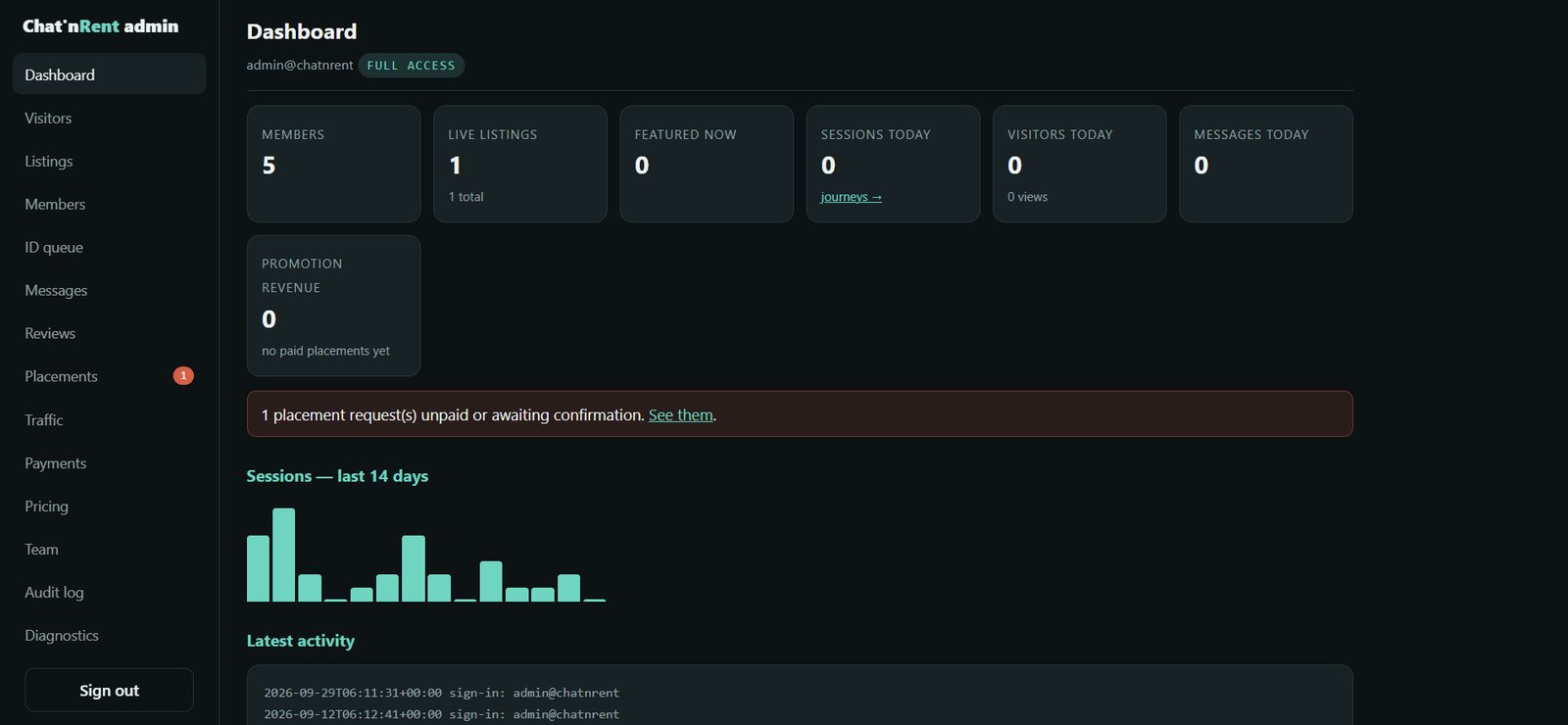
Members, live listings, featured placements, today's sessions, visitors and messages, and promotion revenue — the numbers a marketplace owner checks every morning. Anything that needs a human is surfaced as an alert (here, a placement request that was started but not paid). Under it, sessions for the last 14 days and a raw activity log of sign-ins and admin actions, so there is always an answer to "who did what, when".
2. Visitors — real sessions, not a pixel
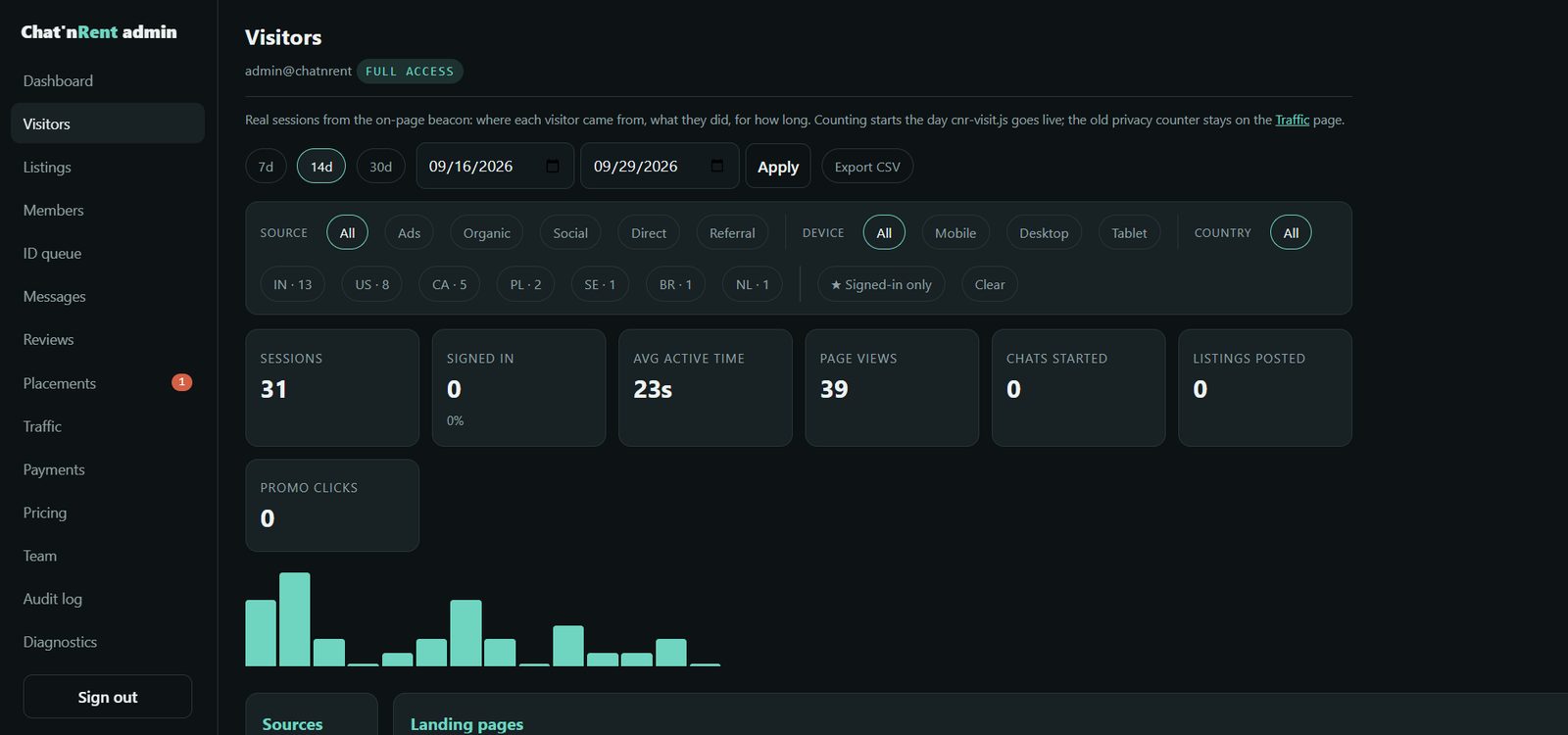
Instead of trusting an external analytics dashboard, the site carries its own lightweight beacon. Every session is recorded with its source (ads, organic, social, direct, referral — with Google click IDs and UTM tags kept), device, country, pages, active seconds and scroll depth, and the actions that matter to a marketplace: signed in, chat started, listing posted, promo clicked. The country chips (IN · 13, US · 8, CA · 5 …) answer "where is this thing being used" instantly; the CSV export feeds any spreadsheet. Because it is first-party, it keeps working when browsers block third-party trackers, and the data belongs to the business.
3. Pricing — every product, every currency, offers included
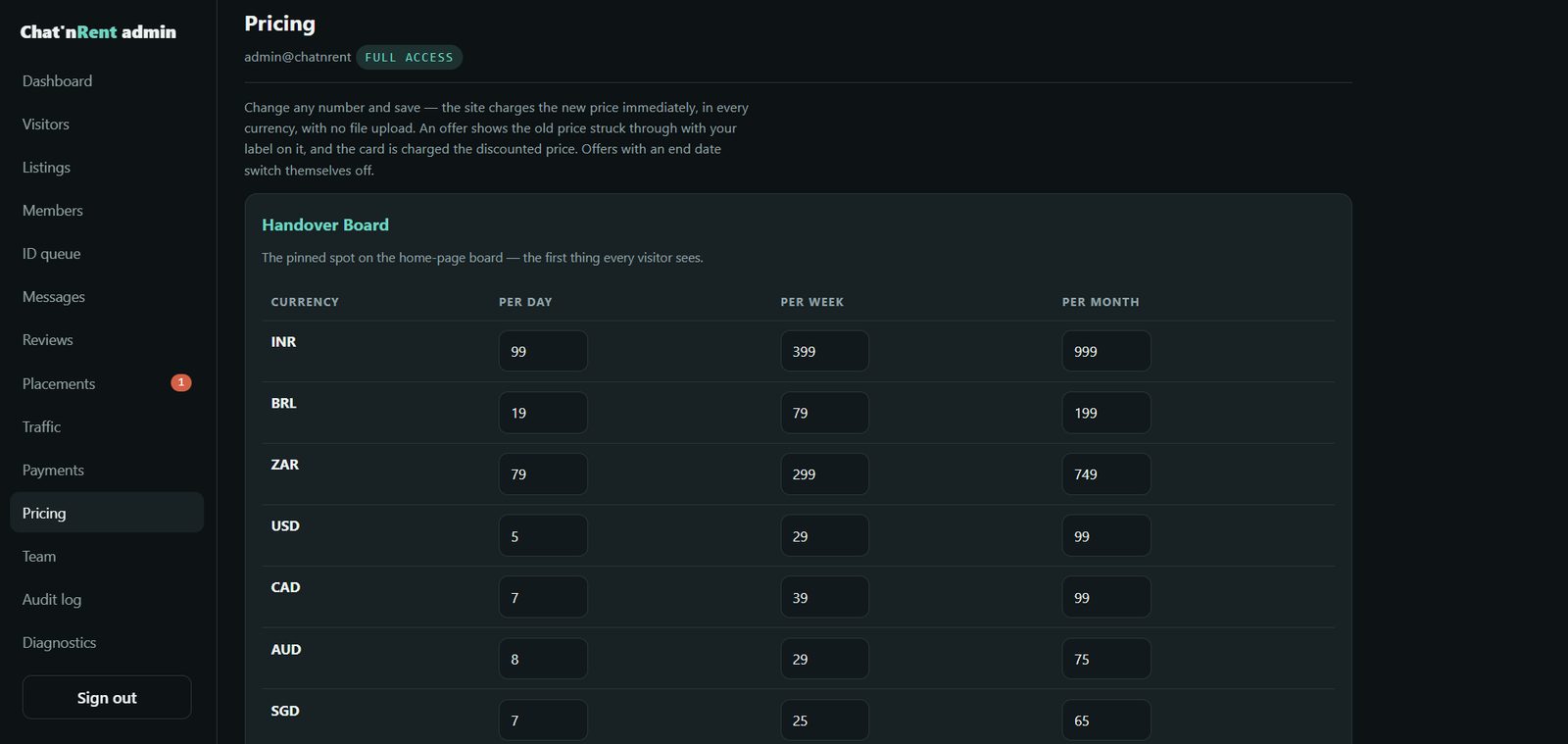
The public site reads its prices from one server-side source, so a change here is live everywhere immediately — the promote modal, the checkout amount and the receipt all agree, in every currency, with no file upload. Offers are created per product with a percentage, a label and an optional end date: the site shows the old price struck through with the label, the card is charged the discounted amount, and expired offers stop applying on their own. This is how a worldwide marketplace runs a "launch week −30%" in Brazil while India stays at list price, from a phone.
The rest of the panel
- ID queue — national-ID uploads reviewed and approved for the "verified" badge; rejected with a reason.
- Members — drill-down per member: listings, messages, reviews, subscription status; suspend or remove scammers in one action.
- Listings — hide/unhide, and manually feature a listing for N days when a support case calls for it.
- Messages and reviews moderation — read any thread, remove abuse, keep reviews genuine.
- Placements and payments — every paid promotion and subscription with its Stripe reference and status.
- Team with two roles — Full access and Limited access — and an audit log of every admin action.
- Diagnostics — a page that checks the live Stripe key, webhook, email, push-notification keys and storage folders and says plainly what is wrong, so "payments stopped" is found before a customer finds it.
How it is built and delivered
The panel is plain PHP on the same Hostinger hosting as the site, with listing, member and visit data in separate storage files so an upgrade never touches live data. Since launch every release has been an "updated files only" package — the site never goes down — and the packager refuses to ship secrets or live data. Stripe handles cards in the visitor's own currency; three payment kinds (featured, board, subscription) route through one webhook.
"A marketplace is 20% the page people see and 80% the screens that keep it honest. Build the 80% first."
Building a marketplace or a two-sided platform?
This is the multi-user end of what we build under admin panels — roles, moderation, payments in many currencies, first-party analytics — delivered in stages so the public site launches while the operations screens grow. See how the pieces compare in our admin panel cost guide, price it with the cost calculator, or ask for a free demo.